
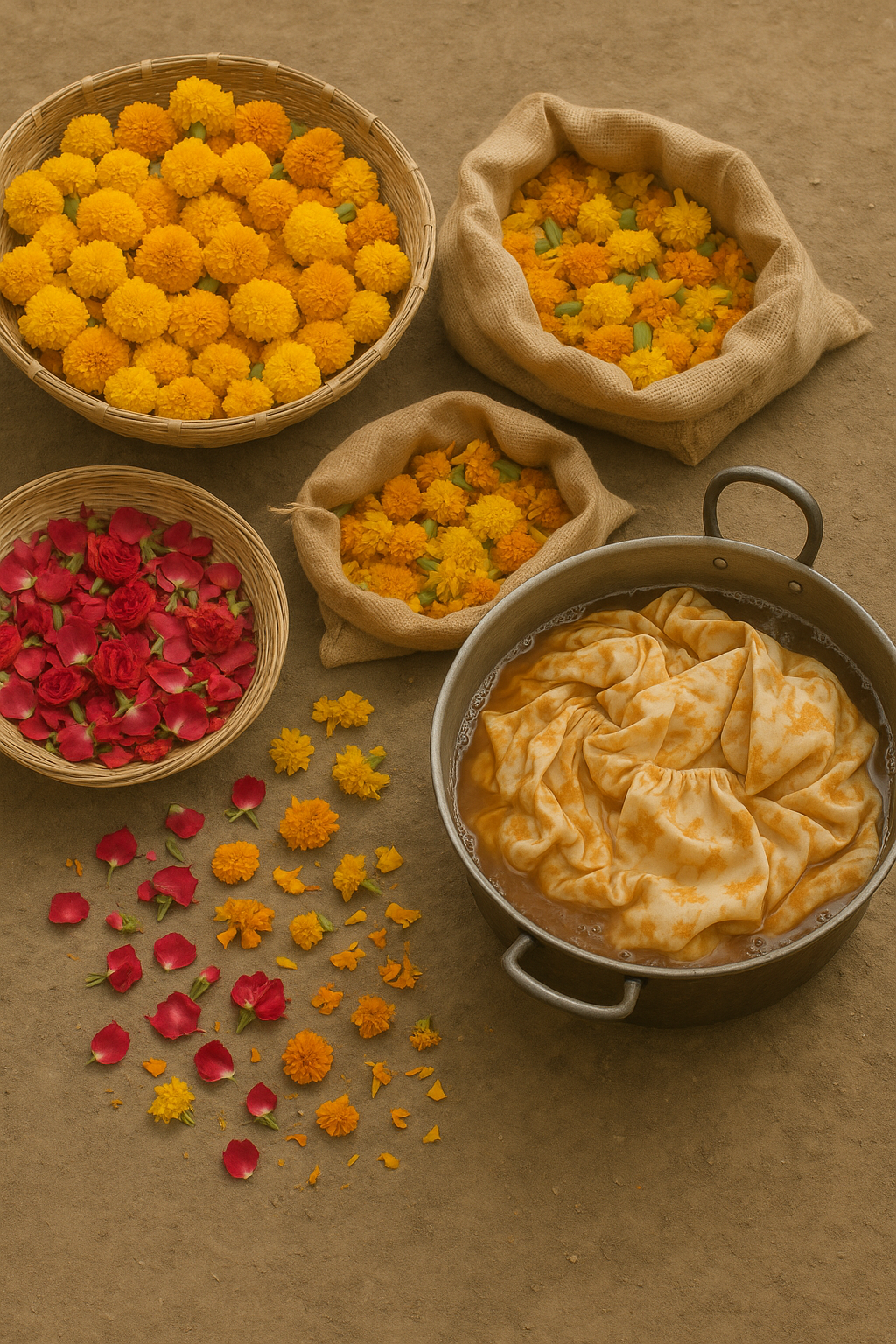
Every year, tons of vibrant flowers are offered at temples and used in weddings across India and other cultures. These blooms—roses, marigolds, jasmine, hibiscus—hold spiritual and celebratory significance. But what happens once the rituals are over?
Most are discarded into rivers, landfills, or roadsides, contributing to pollution and organic waste buildup. But now, a quiet, beautiful revolution is underway—turning these sacred waste flowers into natural dyes for sustainable fashion.
🌸 The Floral Waste Problem No One Talks About
India alone generates nearly 800 million tonnes of floral waste annually from temples and events. While flowers seem harmless, their sheer volume and decomposition in open areas or water bodies lead to:
-
Water pollution (especially from chemical-laced petals)
-
Mosquito breeding
-
Methane emission during decay
-
Blocked drainage systems
Despite being biodegradable, the manner of disposal often harms both environment and public health.
🌼 A Second Life for Sacred Blooms
What if these flowers didn’t have to die a wasteful death?
Social enterprises and eco-conscious designers have begun collecting floral waste from:
-
Temples
-
Wedding venues
-
Hotels and banquet halls
-
Religious festivals (like Ganesh Chaturthi or Durga Puja)
These flowers are sorted, cleaned, sun-dried, and processed to create natural pigments for dyeing fabrics.
🧵 The Process: Dyeing with Devotion
-
Collection: Volunteers or staff gather unsold garlands, altar offerings, or floral décor immediately after the event ends.
-
Segregation & Cleaning: Flowers are sorted by type and color. Inorganic materials like threads, plastics, or wires are removed.
-
Drying & Extraction: Petals are dried naturally or shade-dried to preserve pigment. Then, dyes are extracted using boiling, soaking, or fermentation methods.
-
Fabric Preparation: Natural fabrics like cotton, hemp, or silk are pre-treated (scoured and mordanted) to hold the dye better.
-
Dyeing Techniques: Eco-printing, bundle dyeing, or immersion dyeing techniques are used to create earthy, unique patterns.
-
Finishing Touches: The dyed fabrics are washed in non-toxic fixatives like alum, making them safe and color-fast.
🌿 Why It Matters
1. Circular Economy: It’s a perfect example of waste-to-wealth, extending the life of a resource that would otherwise rot unused.
2. Pollution Reduction: Diverts organic waste from water bodies and landfills.
3. Social Impact: Many initiatives employ women and marginalized communities, empowering them with dignified livelihoods.
4. Healthier Fashion: Natural dyes are non-toxic, hypoallergenic, and safer for both wearer and worker.
🌸 Brands & Movements to Know
-
Phool.co – known for making incense sticks and dyes from temple flowers.
-
Oshadi Collective (India) – works with traditional dyeing communities.
-
Buna Studio & Iro Iro – use floral dye in high-end fashion.
-
Grassroot by Anita Dongre – integrates natural dyes into couture sustainably.
✨ The Spiritual Story in Every Stitch
Clothes dyed with flowers from weddings or temples are more than eco-friendly—they’re emotionally rich. They carry the memory of joy, love, and prayer, woven gently into threads. It’s fashion that honors both the Earth and the divine.
So next time you see a naturally dyed garment, remember: it may once have adorned a bride, sat at a deity’s feet, or floated in a bowl of offerings. What could be more beautiful than wearing a story that once bloomed?